
Supporting Apprenticeship Growth Insights from Wisconsin employers June 2026
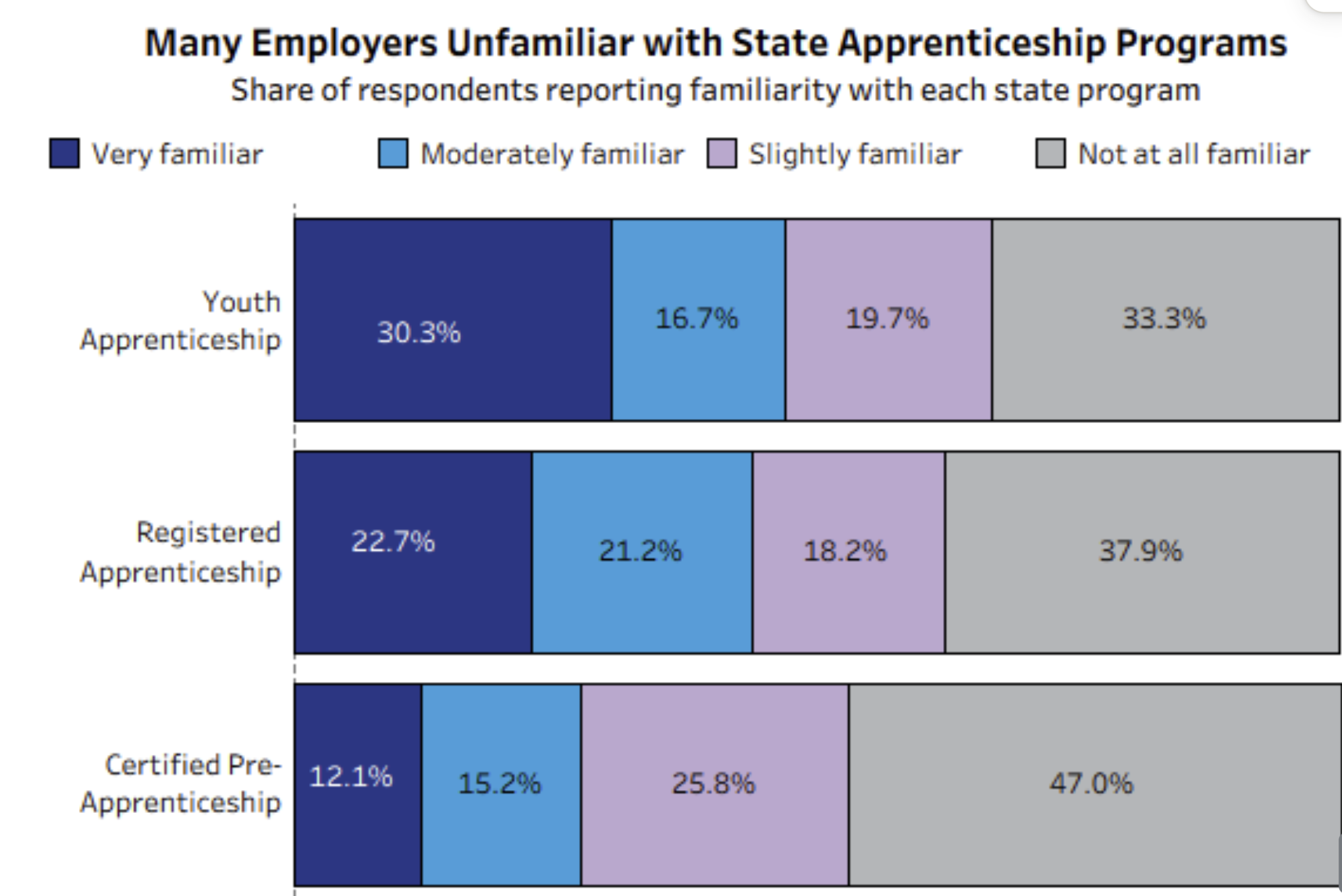
Our survey of Wisconsin employers shows that apprenticeships are widely valued as a means of developing skilled workers, and that many employers see roles within their companies that could benefit from an apprenticeship position or pathway. However, persistent gaps in program awareness, along with cost and capacity barriers – particularly among smaller businesses and those in northwest Wisconsin – suggest a need for expanded employer support and partnership development. READ THE REPORT
Nearly 60% of Wisconsin school districts are projected to receive less in general aid for the upcoming school year than they did in 2025-26, the state DPI announced today.
That includes 92 districts that are expected to see a 15% decrease, the maximum allowed under the state’s hold harmless provision.
Madison, the state’s second-largest district, is expected to see the largest decrease in terms of raw dollars with more than $7 million less in 2026-27 than the most recent school year. That would be a decrease of 14.24%.
The districts that end up receiving less state aid under the formula will be able to backfill that lost revenue with property taxes. Schools are slated to see an increase in their per pupil spending limit of $325 under a veto Dem Gov. Tony Evers issued in the 2023-25 budget that wrote into state law annual hikes for the next four centuries. A failed $1.3 billion surplus package included additional money for general school aids that sought to lower property tax bills.
State law requires DPI to release by July 1 estimates on how general school aids will be distributed for the upcoming school year. It is the biggest pot of money the state sends to schools at nearly $5.6 billion for the upcoming year; that is unchanged from the previous two years after the 2025-27 budget focused additional resources on programs such as special education reimbursement.
The distributions to each district are impacted by factors such as property evaluation and enrollment. The final numbers will be released this fall after enrollments for the 2026-27 school year are determined.
In all, 38% of state districts are projected to see a boost in aid, while nine districts are expected to see no change.
The West Allis district is slated to see a bump of $10.7 million, the largest in the state in terms of raw dollars. That would amount to an increase of 18.8%. The Wauwatosa district is expected to see an increase of more than $6 million, which would amount to a 39.4% boost over last year. That would be the largest increase for any district in terms of percentage.
The Education Department hands off civil rights and special education
The Office for Civil Rights will move to the Department of Justice while the Office of Special Education and Rehabilitative Services will shift to Health and Human Services. Four new interagency departments have been established with Justice and Health and Human Services. CLICK HERE
Education Freedom Accounts could help—and hurt—public school funding
On Jan. 1, individual taxpayers will be eligible for a dollar-for-dollar tax credit for contributions to scholarship-granting organizations, which can then use the funds to distribute scholarships that cover private school tuition, tutoring, special education programs, and other qualifying expenses. CLICK HERE

WISCONSIN EXAMINER - Gov. Tony Evers, Assembly Speaker Robin Vos (R-Rochester) and Senate Majority Leader Devin LeMahieu (R-Oostburg) — Wisconsin’s three leaders all of whom are set to retire this year — announced a $1.8 billion deal Monday to provide additional funding to Wisconsin schools along with significant tax cuts. The deal goes to the Legislature this week, where some members are already balking. Baylor Spears has the story.
WisPolitics - Senate Minority Leader Dianne Hesselbein dismissed a $1.8 billion surplus spending deal from GOP leaders and Gov. Tony Evers as coming from “three men who will not be in elected office next year.”
QUOTE OF THE DAY
“I was really excited that pretty much every single candidate acknowledged the fact that this is a broken system in Wisconsin, and that we don't choose to invest in our kids. We put that burden on philanthropy or we put that burden on local governments and it's just not something that could be carried alone by philanthropy and local governments.”
– Jackie Scott of the Wisconsin Partnership for Kids, speaking after a forum with gubernatorial hopefuls Tuesday
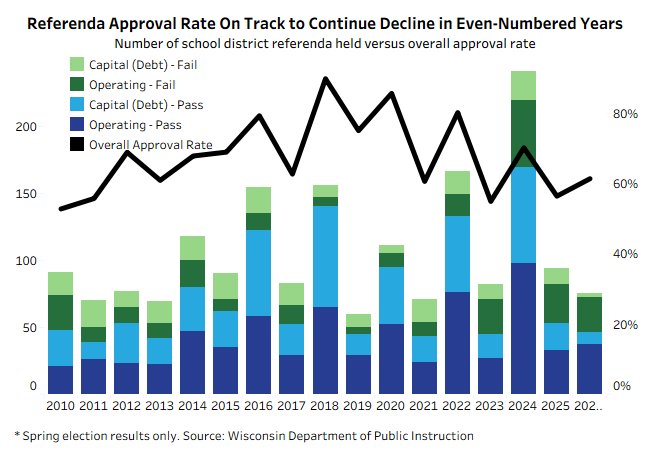
K-12 Referenda Add to Revenue Gaps - Focus | April 2026
Voters across Wisconsin approved 46 of 75 school district referenda this spring, a 61.3% approval rate that aligns with a recent downward trend. The state’s overall system for financing K-12 schools, along with recent increases in the number of referenda, has contributed to a widening gap between school districts receiving the most and least funding under state revenue limits, raising questions about the system’s fairness.

Chronic absenteeism remains one of the most significant challenges facing schools across the United States. While attendance has gradually improved since the height of the COVID‑19 pandemic, rates are still far higher than before 2020.
A new report from the HEDCO Institute, based on a 2026 meta-analysis, offers five promising approaches for reducing chronic absenteeism, which include changes to school culture and more engagement with parents.

Congress Approved Next Year’s Federal School Funding. What’s Next?
Congress has approved next year’s federal school funding—but uncertainty around education budgets hasn’t disappeared.
While the 2026 budget keeps funding for major programs like Title I and IDEA are largely level, school districts are still navigating the effects of recent grant cancellations, delays, and shifting federal priorities.
Friday, April 24
2:00 – 3:00 P.M. ET
REGISTER
