
WiRSA (Wisconsin Rural Schools Alliance)
Strong Schools - Strong Communities
Ready. Set. Rural.
—2026 Call for Proposals is Open—
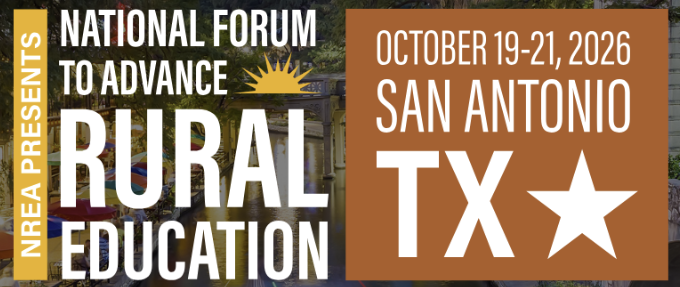
2026 National Forum to Advance Rural Education
October 19-21, 2026 | San Antonio, Texas
The Call for Proposals is now open for the 2026 National Forum to Advance Rural Education—the nation’s premier conference focused on advancing opportunity and innovation in rural schools and communities.
Hosted by the National Rural Education Association (NREA) in partnership with the Texas Rural Education Association, the Forum brings together rural educators, school and district leaders, higher education faculty, researchers, policymakers, and community partners from across the country.
2026 Theme: Ready, Set, Rural: Creating Opportunity Everywhere
This year’s theme celebrates the readiness, resilience, and resourcefulness of rural communities—and the power of education to create pathways for learners of all ages.
What’s New for 2026: Rural Innovation & Impact Showcase Competition
A new national competition spotlighting proven, rural-centered innovations with measurable impact. Finalists will present live at the Forum, with the winning initiative receiving a $5,000 award.
3 Ways to Present
1. Learning Sessions highlighting innovative practice
2. Research Sessions advancing rural education research
3. Rural Innovation & Impact Showcase Competition
Proposals Due: March 27, 2026
Bring your ideas. Share your impact.
Join us in San Antonio for #RuralEdForum 2026.
New this year is our third day's Innovation & Impact Showcase!
We are inviting K-12 schools who are doing amazing working their rural communities that is moving the needle to apply.
The Top Five applications will be able to pitch their innovation on that third day and be eligible for winning a grant prize of $5,000!
The information on the application process is attached and the link to the Cvent site is here: Home - 2026 National Forum to Advance Rural Education

Teacher Training and Recruitment Grants available
The Wisconsin Department of Workforce Development is accepting applications for Teacher Training and Recruitment grants. This expanded Wisconsin Fast Forward grant program aims to recruit and prepare individuals to teach in school districts in Wisconsin with the most prevalent need.
Up to $1 million is available to 501(c)(3) or (4) nonprofits to design and implement programs that will increase the number of instructors working in low income and/or urban Wisconsin schools. Qualified Wisconsin nonprofit organizations can apply for up to $250,000 to recruit, train, and license teachers.
Applications are due 3 p.m. CST on Thursday, March 19, 2026.
Find additional information in the Grant Program Announcement and related grant program materials at the Wisconsin Fast Forward website.
Thank you for your interest in the Wisconsin Fast Forward grant program.
John Roos
Director, Office of Skills Development
Wisconsin Department of Workforce Development
New Wisconsin Fast Forward grant now available
A new grant opportunity is available from the Wisconsin Department of Workforce Development's Office of Skills Development. Under the Wisconsin Fast Forward (WFF) program the grant opportunity funds innovative and collaborative customized worker training programs in all industry sectors.
Key features of the program:
Grants are available to companies of any size in all industry sectors.
Award amounts range from $5,000 to $400,000. A consortium of employers may apply for more than $400,000.
Cash or in-kind match equal to 50% of the grant award amount is required.
Grantees must complete training of at least 85% of the contracted number of trainees.
At least 65% of trainees must be placed in positions with placement partners in the grant application that require skills taught in the training.
At least 75% of incumbent trainees must receive increased wages.
Applications are due by 3 p.m. CST on Wednesday, Feb. 18, 2026.
Find additional information or apply on the WFF website.
Thank you for your continued interest in the WFF grant program.
John Roos
Director, Office of Skills Development
Department of Workforce Development
(608) 733-3918
February 2026 • Community Economic Development Program • UW Extension
Data Snapshot: Rural Entrepreneurship
Survey Finds Rural Wisconsinites are More Likely to Have Entrepreneurial Experience than their Urban Counterparts
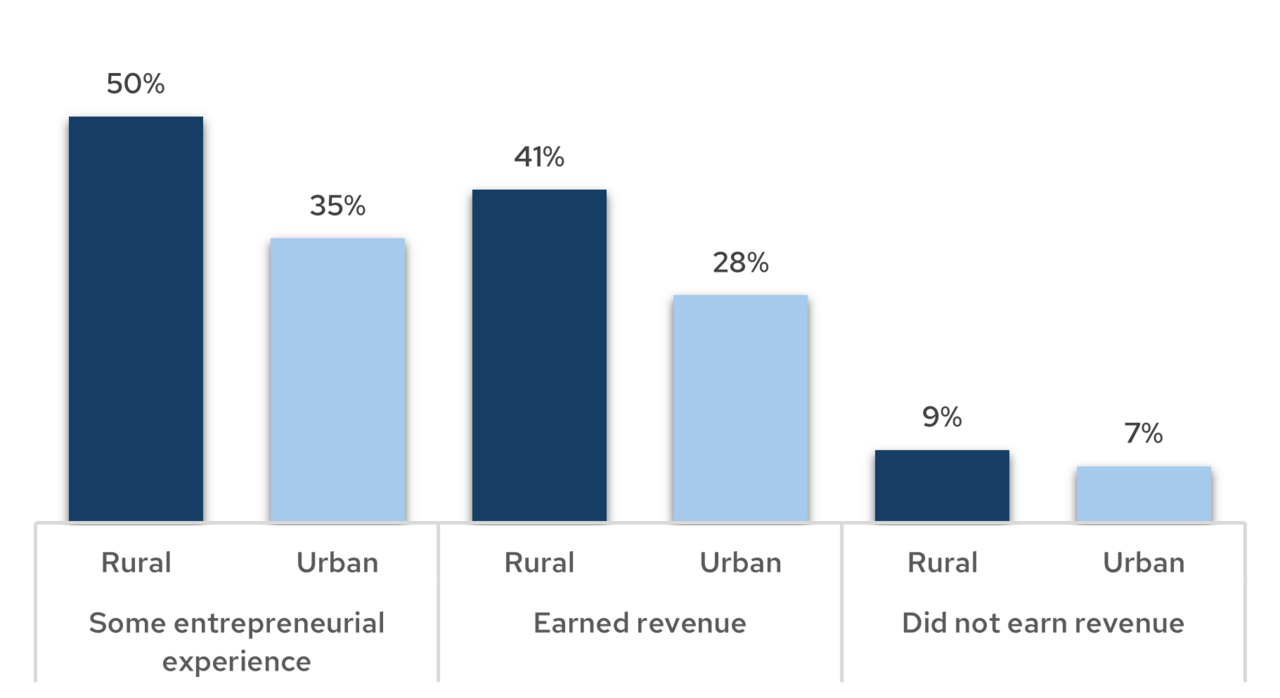
A 2024 survey of 1,628 Wisconsin residents fielded by UW Extension and the University of Minnesota Extension asked respondents three questions: “Have you ever owned a business?” “Have you ever been involved in starting a business that earned revenue?” and “Have you ever discontinued a business before it earned revenue?”
Results show that rural Wisconsinites are more likely than their urban counterparts to answer “yes” to each question. Roughly 50% of rural respondents, as compared to 35% of urban respondents, reported some form of entrepreneurial experience, either owning or starting a business. Roughly 41% of rural respondents, as compared to 28% of urban respondents, reported involvement in a business that earned revenue. When asked if they had been involved in an entrepreneurial venture that had discontinued operations before earning revenue, rates between the two groups were similar, 9% for rural Wisconsinites and 7% for urban Wisconsinites.
AB 357 / SB 366 - Technical education equipment grants
AB 803 - Workforce training grants
AB 974 - A public affairs network trust fund, grants to the WisconsinEye Public Affairs Network, and making an appropriation.
SB 673 - Relating to: school board policies on appropriate communication with pupils.
SB 699 - Relating to: alternative methods of providing pupil transportation services.
SB 785 - Relating to: including information about investigations of license holders in an online licensing portal maintained by the Department of Public Instruction
AB 100 - Relating to: designating athletic sports and teams operated or sponsored by public schools or private schools participating in a parental choice program based on the sex of the participants.
AB 102 - Relating to: designating University of Wisconsin and technical college sports and athletic teams based on the sex of the participants.
AB 103 - Relating to: school board policies related to changing a pupil’s legal name and pronouns.
AB 614 - Relating to: a teacher’s authority to manage the teacher’s class, parental notification of disruptive or violent behavior at school, and a school district’s code of conduct.
AB 677 - Relating to: creating a crime of grooming a child for sexual activity and providing a penalty
There was an Assembly public hearing and executive session on Thursday, Feb. 5.
AB 990 — Personal financial literacy high school graduation requirement.
AB 948 — Policies to prohibit the use of wireless communication devices during the school day in public schools.
This bill revisits the cell phone/communication device ban. 2025 Wisconsin Act 42
AB 948 requires boards to adopt policies that restrict device use throughout the day, not just during instructional time.
WISCONSIN EXAMINER - Wisconsin lawmakers seek ‘bell-to-bell’ cell phone ban and internet regulations for children
AB 1003 — The voluntary surrender of a license issued by the Department of Public Instruction during an investigation of immoral conduct, prohibited agreements related to information related to an investigation of immoral conduct, and records related to an investigation of immoral conduct.
AB 1004 — Prohibiting education employers from entering into certain agreements related to information about alleged immoral conduct by an employee and civil immunity for information provided to a prospective employer.
The Legislative Democrats did roll out a package of teacher workforce proposals
LRB-6172: Grants to school districts to pay student teachers an hourly wage, granting rule-making authority, and making an appropriation.
LRB-4546: Adding a teacher representative to school boards.
LRB-4254: Grants to encourage individuals to pursue a career in teaching or to facilitate teacher licensure, granting rule- making authority, and making an appropriation.
LRB-4488: Longevity bonuses for teachers in school districts.
LRB-4489: Paid preparation time for teachers.
LRB-6261: Establishing minimum salaries for public school teachers.
LRB-6173: Requiring school boards to compensate teachers for time spent on nonclassroom services.
Appropriations Update
On Tuesday, Congress passed a bipartisan, bicameral Fiscal Year (FY) 2026 Labor, Health and Human Services, and Education (LHHS) funding package, along with 4 other spending bills and a two-week stopgap for the Department of Homeland Security (DHS) to give Congress more time to negotiate reforms for immigration enforcement. We have a breakdown of the LHHS bill on The Leading Edge blog.
Amid the DHS negotiations, Senate Minority Leader Chuck Schumer and House Minority Leader Hakeem Jeffries issued a letter outlining their priorities. Of interest to district leaders, they ask for Congress to protect sensitive locations and prohibit enforcement activities near certain areas, including schools. The DHS stopgap bill expires on February 13.
ED Issues FY26 Small, Rural School Achievement Program Application Notice
This week, the Department of Education issued a notice of application deadline for FY26 Small, Rural School Achievement Program—one of the grant programs within the Rural Education Achievement Program (REAP). The applications will be available until April 13, 2026 and the deadline to submit is May 18, 2026. The Department will send an email with a unique application link to each local education agency (LEA) that is eligible and estimated to receive a positive allocation ( i.e., an estimated amount greater than $0.00) for an FY 2026 SRSA grant award. The Master Eligibility Spreadsheet, which lists each LEA eligible to apply for FY 2026 SRSA or RLIS funds, should be available here soon. This announcement indicates that the Department has returned to its standard timeline for the program following last year’s delayed application.

Behavioral Threat Assessment and Management (BTAM) Training Sessions
OSS will be providing opportunities statewide for BTAM training in 2026. Dates and locations are listed below. Registration links are also available on the OSS website Training Opportunities page. If you have any questions, please do not hesitate to contact our Threat Assessment Specialist, Sue Williams, at Susan.Williams@wisdoj.gov.
Friday, February 13 – Necedah Area School District – Necedah
Friday, February 27 – CESA 3 – Fennimore
Monday, March 2 (part 1) and Tuesday, March 10 (part 2) – Virtual
Friday, March 13 – Location TBD – Antigo
Wednesday, April 8 – Mosinee School District – Mosinee
Wednesday, April 22 – Mosaic Technologies Training Center – Cameron
Thursday, June 11 – Menasha High School – Menasha
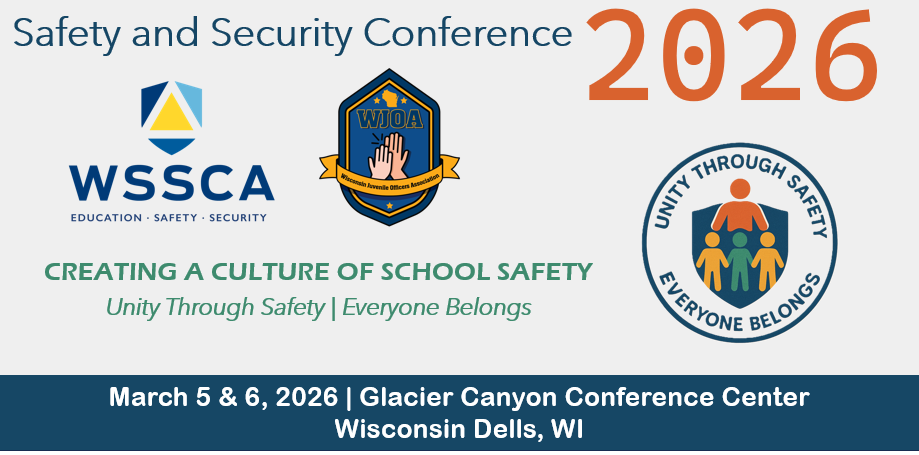
2026 Annual Safety and Security Conference
If you're registered, we look forward to seeing you!
If you're not registered, there's still time.
In partnership with the WJOA, we have a great conference planned to include breakout sessions, featured speakers, and exhibitors that specialize in school safety and security. Please forward this email on to others that may benefit from the opportunity to attend the conference.
CLICK HERE TO REGISTER

The WiRSA board has made scholarship changes
The scholarships for both our general WiRSA scholarship and our pre-teacher scholarship have increased to $1000, and the selection committee will evaluate applicants' video presentations.
General WiRSA Scholarship
The scholarship will be awarded annually to one graduating high school senior from each of the four membership regions of Wisconsin, as specified in the organization’s bylaws. An additional at-large scholarship will be awarded to the next-highest-scoring applicant. Each recipient will receive a one-time cash scholarship of $1000 to be used by the student to help defray the costs of post-secondary education and related expenses. A video of the applicant addressing the following information is required for the application. Consideration will be given to professionalism, communication, and content. The video should be limited to 5 minutes.
What are the benefits of attending a rural school?
Why are you choosing the field of teacher education?
What is the value of growing up in a rural community, and what personal values have you gained from your experience?
SENIOR - Post-Secondary Teacher Education Scholarship Details
The scholarship will be awarded annually to one graduating high school senior from each of the four membership regions of Wisconsin, as specified in the organization’s bylaws. An additional at-large scholarship will be awarded to the next-highest-scoring applicant. Each recipient will receive a one-time cash scholarship of $1000 to be used by the student to help defray the costs of post-secondary education and related expenses. A video of the applicant addressing the following information is required for the application. Consideration will be given to professionalism, communication, and content. The video should be limited to 5 minutes.
What are the benefits of attending a rural school?
Why are you choosing the field of teacher education?
What is the value of growing up in a rural community, and what personal values have you gained from your experience?