WiRSA (Wisconsin Rural Schools Alliance) - Strong Schools - Strong Communities

POSSIBLE DEAL COMING TOGETHER - April 28
Legislators have been asked for availability for a possible floor session date the week of May 11. While nothing has been announced, it could be early signs that a deal is close between the Legislature and the Governor on issues which could include redistricting, tax rebate, tax cut, education funding, special education funding, and more.
GOVERNOR’S MOST RECENT PROPOSAL
Total=$1.3 Billion
$200 million in additional special education aid
$450 million in general school aids
$550 million in school levy tax credit
$97.3 million towards exempting tax on tips
Dee Pettack, Executive Director (SAA), said it best!
The ask is simple: Use a portion of the state’s $2.5 billion surplus to fulfill the shortfall of funding for special education and provide property tax relief to our communities.
Take Action Today: Reach out to your legislators and urge them to:
Support using surplus funds to meet at least the promised 42% and 45% reimbursement rates
Provide certainty for school district budgets
Reduce pressure on local property taxpayers
School districts are making staffing and programming decisions right now for the upcoming school year. Delays in action only make those decisions more difficult. To find your legislator's contact information, please click here.

WASB’s strong leadership is focused on setting the record straight with the cost-effectiveness of Public vs. Voucher Schools
WASB is LEADING the way by launching a new resource and advocacy campaign designed to equip school leaders with the messaging and talking points they need to defend their local public school districts from misleading claims that so often dominate the narrative on public education.
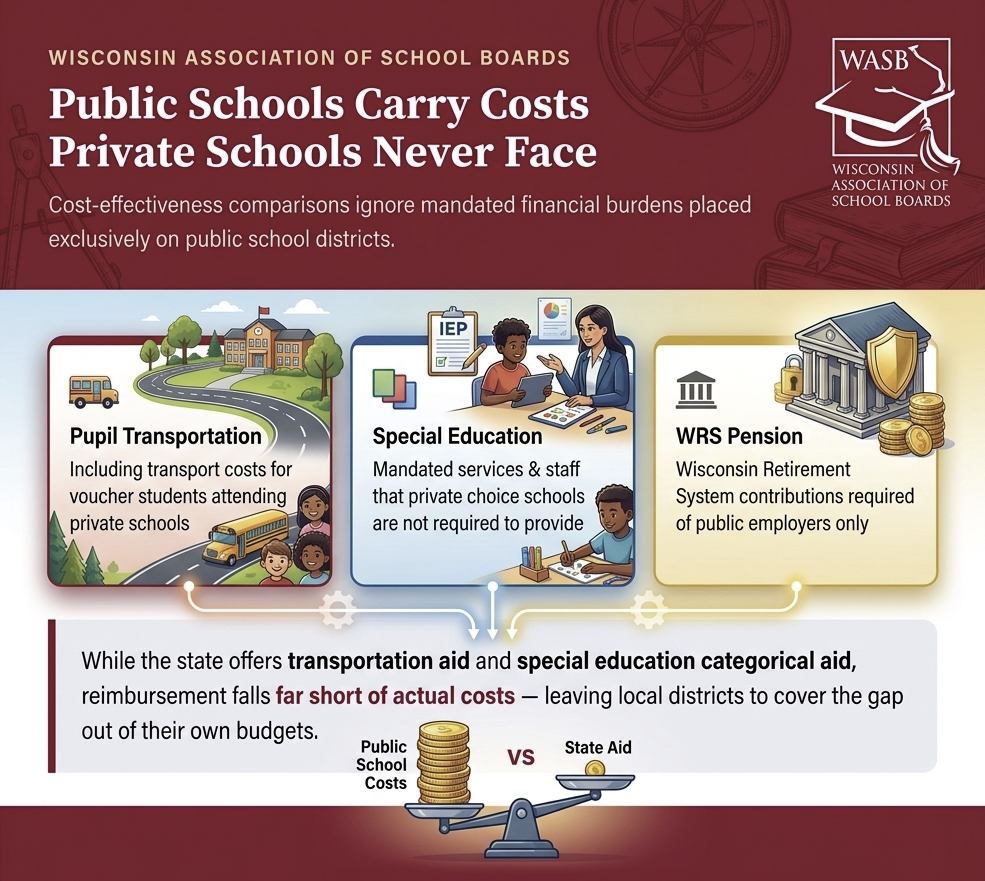
In their Part 1 series WASB focuses on the claim: When accounting and adjusting for different levels of income, students with disabilities, and English learners, private voucher schools deliver better student achievement than public schools with less money.
by David Martin | Apr 29, 2026 | Legislative Update Blog, Setting the Record Straight, State Issue
FACT: Assertions about cost-effectiveness ignore that public schools have certain costs mandated upon them that private schools do not. These include pupil transportation costs (including the costs of transporting voucher pupils), special education costs, and pension (WRS) costs, to name a few. Private schools have none of these costs mandated upon them. While some of these costs are partially reimbursed by the state (transportation aid, special education categorical aid) this reimbursement is nowhere near adequate to cover these costs meaning districts pick up a large portion of the tab themselves.
Sources: Transportation; Special Education; WRS Pension Costs
FACT: Reports on the cost effectiveness of voucher systems only includes details of their public financing. There is no consideration given to the amount of private donations or funding raised through tuition that these schools collect.
Note: The WASB has created this initiative to equip school leaders with accurate information and effective talking points. Think of these as a foundation — they become most powerful when paired with your district’s own data, experiences, and stories. Adapt them, expand on them, and use them to strengthen trust in Wisconsin’s public schools.
Take a moment to watch this great video by Captivate Media, WSPRA, and WASBO breaking down public school funding in Wisconsin.

Governor Evers
Gov. Evers, DWD Kick Off National Apprenticeship Week Celebrating Fifth Consecutive Year of Record-Breaking Enrollment in State’s Youth Apprenticeship Program
Portrait of a Graduate Listening Sessions
The Wisconsin Department of Public Instruction is developing a “Portrait of a Graduate,” a shared vision of what students should know, value, and do by graduation. It reflects community priorities and includes both academic rigor and the durable skills needed for success in life, career, and civic engagement. This work clarifies key outcomes and helps ensure schools are preparing students for a changing world. Your input matters!
Please join an in-person listening session or a virtual session. For more information about listening sessions, visit https://dpi.wi.gov/families-students/programs-initiatives/portrait-graduate.
Handout - Flyer
Summary of 2025-26 Laws Affecting K-12 Education
The 2025-26 legislative sessions have concluded, and 247 bills were signed into law by Gov. Tony Evers. The DPI has prepared a summary of enacted legislation that impacts K-12 education, organized by topic area and including links to the full act text and Legislative Council memos for each bill.
The summary includes new laws related to educator licensure and development, grants and scholarship programs, school district administration and operations, transportation, instruction, and student health and wellness. It also includes a list of education-related bills vetoed during the session.
This resource is intended to help school and district leaders quickly identify and review changes in state law that may impact local policy and practice.
The full summary is available on the DPI’s website. For questions and additional information, please contact Legis.Inquiry@dpi.wi.gov.
State-Required Seclusion and Restraint Data to be Released on Thursday
The DPI will release its annual seclusion and restraint report for the 2024-25 school year on Thursday, April 30.
Under state law (2019 Wisconsin Act 118), all Wisconsin schools are required to annually report information on the use of seclusion and physical restraint to the DPI. This reporting reflects information submitted by districts as required by statute.
The report will include the required statewide information submitted by schools, along with updated resources and supports available to districts.
The DPI continues to offer tiered assistance to schools based on reported incidents, with outreach and support available to any school reporting one or more instances. More information on this leveled support system is available on the DPI’s website.
The report and related resources will be available on the DPI’s website on Thursday, including access to school- and district-level information.
2026 Summer Institute
Don’t miss your chance to join one of Wisconsin’s most energizing professional learning experiences of the year! The 2026 Summer Institute, hosted by the Wisconsin Department of Public Instruction (DPI), brings school teams together for four days of deep learning, collaboration, and innovation.
Deadline to Apply: Friday, May 1, 2026
Location: Lowenwood Education Center, Land O’ Lakes
Dates: June 22 – 25, 2026
What Your Team Receives
Participating teams will engage in a professional learning experience designed to spark creativity and support systems-level change. In addition, each team receives:
$2,000 in implementation funds to support innovation work, provide honoraria to staff, or meet other identified needs
Explicit, systems-level professional development from Wisconsin educators engaging in innovative work to highlight what is possible
Ongoing support throughout the 2026-2027 school year via online sessions to help operationalize your action plan
Learn more: Transforming Systems for Innovation
Informational Update on the Lawsuit “Wisconsin PTA, et.al. V. Wisconsin Assembly”
Click the Logo above to access the website
In February 2026, Wisconsin community members, school districts, and education associations filed a lawsuit against the Wisconsin State Assembly, Wisconsin State Senate, and members of the Joint Committee on Finance – Wisconsin PTA, et.al. V. Wisconsin Assembly.
The Wisconsin Rural Schools Alliance recognizes and appreciates the courage and leadership of our member districts and organizations serving as plaintiffs in the effort to secure fair and adequate funding for Wisconsin’s public schools.
From April 20, 2026 - After a group of Wisconsin school districts, parents, teachers, students and advocates filed a lawsuit arguing that the state Legislature is not fulfilling its constitutional obligation to provide a “sound basic education” under the current school funding formula, Republicans and school choice advocates asked to have the suit dismissed. Baylor Spears has the story.
Do you want to understand more about the lawsuit?
Law Forward, representing the lawsuit, is willing to present the case and answer any questions your organization may have. If Interested, please use this form to request a speaker for your organization: https://www.fundwipublicschools.org/request-a-speaker
2026 Congressional App Challenge
Submissions Due October 26, 2026
The Congressional App Challenge is the official student STEM competition of the U.S. House of Representatives. It's an annual nationwide competition hosted by Members of Congress designed to inspire middle and high school students to explore STEM fields.
Incorporating the Congressional App Challenge into your curriculum is a simple and impactful way to inspire middle and high school students, encourage hands-on STEM learning, and connect them to their elected representatives. Students can participate individually or in teams of up to four, making it easy to adapt to any classroom or program setting.
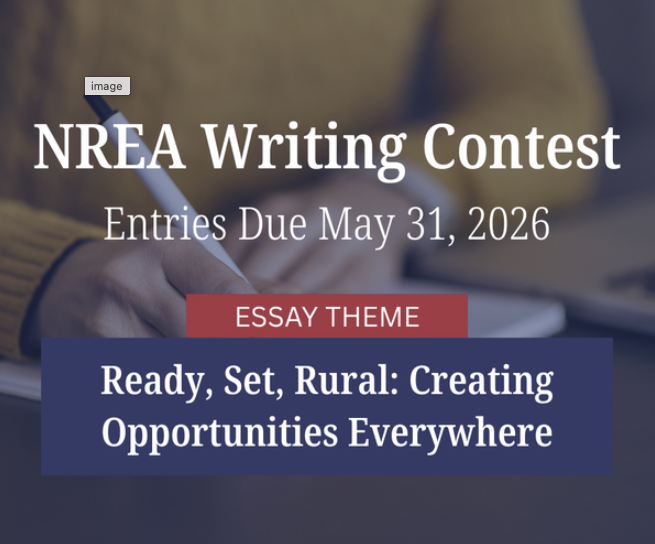
2026 NREA Writing Contest Open Now!
Ready, Set, Rural: Creating Opportunities Everywhere
Submissions Due May 31, 2026
Rural communities are full of creativity, resilience, and unique opportunities. Through this contest, students K-12 will share their perspectives on rural life, the importance of education in rural areas, and ideas for creating opportunities that can make a difference locally or nationally. Learn more and submit by May 31.
Schedule your summer or back-to-school PD session today! Sign up for your FREE Learning Blade account here.
Launch into Learning for the 2026-2027 School Year!
Get a head start on Fall 2026! Now’s the time to prep your STEM, Computer Science, and CTE curriculum with Learning Blade’s 500+ standards-aligned lessons for grades 5–9. Plan Ahead: Book your FREE summer or back-to-school PD and explore how Learning Blade brings real-world careers and hands-on learning to life.
Why Learning Blade?
● 500+ interactive STEM, CS, and CTE lessons
● Ready-to-use plans for busy teachers
● Career exploration to motivate students
● Engaging, team-based projects with 3D printing, design & more

QUOTE OF THE DAY
“I was really excited that pretty much every single candidate acknowledged the fact that this is a broken system in Wisconsin, and that we don't choose to invest in our kids. We put that burden on philanthropy or we put that burden on local governments and it's just not something that could be carried alone by philanthropy and local governments.”
– Jackie Scott of the Wisconsin Partnership for Kids, speaking after a forum with gubernatorial hopefuls Tuesday

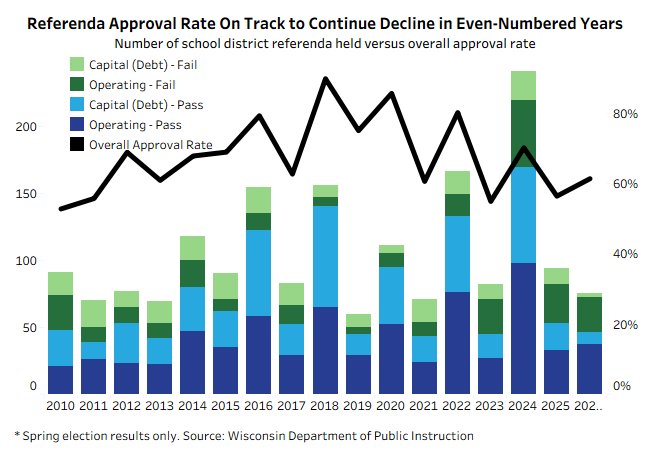
K-12 Referenda Add to Revenue Gaps - Focus | April 2026
Voters across Wisconsin approved 46 of 75 school district referenda this spring, a 61.3% approval rate that aligns with a recent downward trend. The state’s overall system for financing K-12 schools, along with recent increases in the number of referenda, has contributed to a widening gap between school districts receiving the most and least funding under state revenue limits, raising questions about the system’s fairness.

Chronic absenteeism remains one of the most significant challenges facing schools across the United States. While attendance has gradually improved since the height of the COVID‑19 pandemic, rates are still far higher than before 2020.
A new report from the HEDCO Institute, based on a 2026 meta-analysis, offers five promising approaches for reducing chronic absenteeism, which include changes to school culture and more engagement with parents.
Congress Approved Next Year’s Federal School Funding. What’s Next?
Congress has approved next year’s federal school funding—but uncertainty around education budgets hasn’t disappeared.
While the 2026 budget keeps funding for major programs like Title I and IDEA are largely level, school districts are still navigating the effects of recent grant cancellations, delays, and shifting federal priorities.
Friday, April 24
2:00 – 3:00 P.M. ET
REGISTER
WiRSA Conference 2026 ”Celebrating Innovation and Resilience”
WiRSA Conference Room Reservations - OPEN NOW!
Rate: $101.00 Single Occupancy State Rate - $124.00 Double Occupancy State Rate
Guests can book their reservations online 24 hours a day by using the following link: Holiday Inn Express: WiRSA Conference 2026
Making reservations over the phone, please call 715-344-0200 and press #1. When making reservations, please reference the group name, WiRSA Conference 2026, or the Group Block Code: WIR.
Group rate will be available until 09/28/2026 (or until the block is full). Remaining rooms in your will be released for general reservations at the hotel's prevailing daily rate, which may be higher than your group rate.
BOOK YOUR ROOM TODAY!
WiRSA Conference Registration- OPEN NOW!
Thursday, October 29 & Friday, October 30, 2026
Welcome Reception
Wednesday, October 28, 2026 - 6:00 p.m.
Stevens Point Convention Center - Stevens Point, WI
A conference for administrators, board members, teachers, CESA employees, higher education professionals, public library administrators, elected officials, and citizens passionate about rural school and community issues.
WiRSA Conference - CALL FOR PROPOSALS
“Celebrating Innovation & Resilience” focuses on how rural schools thrive by responding to challenges and limitations with creative solutions. Breakout sessions will align with one of the following tracks:
Resource Management & Collaboration: Strategies for utilizing limited resources; managing budgets; addressing declining enrollment; and responding to community needs, such as school-sponsored child care or health care/mental health partnerships.
Technology & Future Readiness: Focusing on emerging technologies, preparing students for a workforce shaped by AI, and leveraging AI tools for school leaders.
Educational Pathways & Programs: Highlighting innovative educational programs and effective classroom practices, including Academic and Career Planning (ACP), high school pathways, dual credit options, and the development of partnerships with higher education and businesses.
Proposals are due by Friday, June 26, 2026
Policy Intelligence and Education News

Wisconsin School Safety Coordinators Association