WiRSA (Wisconsin Rural Schools Alliance) - Strong Schools - Strong Communities

WiRSA Conference 2026
”Celebrating Innovation and Resilience”
WiRSA Conference Room Reservations - OPEN NOW!
Rate: $101.00 Single Occupancy State Rate - $124.00 Double Occupancy State Rate
Guests can book their reservations online 24 hours a day by using the following link: Holiday Inn Express: WiRSA Conference 2026
Making reservations over the phone, please call 715-344-0200 and press #1. When making reservations, please reference the group name, WiRSA Conference 2026, or the Group Block Code: WIR.
Group rate will be available until 09/28/2026 (or until the block is full). Remaining rooms in your will be released for general reservations at the hotel's prevailing daily rate, which may be higher than your group rate.
BOOK YOUR ROOM TODAY!
WiRSA Conference Registration- OPEN NOW!
Thursday, October 29 & Friday, October 30, 2026
Welcome Reception
Wednesday, October 28, 2026 - 6:00 p.m.
Stevens Point Convention Center - Stevens Point, WI
A conference for administrators, board members, teachers, CESA employees, higher education professionals, public library administrators, elected officials, and citizens passionate about rural school and community issues.
WiRSA Conference - CALL FOR PROPOSALS
“Celebrating Innovation & Resilience” focuses on how rural schools thrive by responding to challenges and limitations with creative solutions. Breakout sessions will align with one of the following tracks:
Resource Management & Collaboration: Strategies for utilizing limited resources; managing budgets; addressing declining enrollment; and responding to community needs, such as school-sponsored child care or health care/mental health partnerships.
Technology & Future Readiness: Focusing on emerging technologies, preparing students for a workforce shaped by AI, and leveraging AI tools for school leaders.
Educational Pathways & Programs: Highlighting innovative educational programs and effective classroom practices, including Academic and Career Planning (ACP), high school pathways, dual credit options, and the development of partnerships with higher education and businesses.
Proposals are due by Friday, June 26, 2026

The governor signed two bills on March 6th. Strengthening protections for children against sexual grooming.
The 2025 Wisconsin Act 88 (previously known as AB 677) addresses a gap in Wisconsin legislation by establishing a distinct offense for grooming a child.
In 2025, Wisconsin enacted Act 89, previously known as Senate Bill 673, which focuses on communication protocols within educational settings. This new legislation mandates that the governing bodies of all school types—public, private, and charter—establish clear policies regarding appropriate communication between students and school staff or volunteers.
Assembly Bill 677, now 2025 Wisconsin Act 88:
Creates a crime of grooming a child for sexual activity and provides graduated penalties;
Adds the new crime to various cross-references, including to the list of offenses whose statute of limitations end when the victim reaches the age of 45;
Adds the crime of grooming to the definition of “abuse” for the purposes of the Children’s Code;
Provides that consent is not an issue or a defense for the purposes of the crime of grooming; and
Modifies the current law offense of sexual misconduct by a school staff person or volunteer by clarifying that victims under that offense include any pupil enrolled in a school in Wisconsin, rather than limiting it to a particular school.
Senate Bill 673, now 2025 Wisconsin Act 89:
Requires each school district, private school, and independent charter school in the state to adopt a policy on appropriate communication among employees and volunteers, when acting in their official capacity, and students by Sept. 1, 2026;
Requires the policy to include a range of consequences up to termination for policy violations;
Requires the policy to apply to communications both during and outside of school hours, with standards for appropriate content and methods of communication;
Requires the Department of Public Instruction (DPI) to develop and make available free training about identifying, preventing, and reporting grooming, as well as professional boundary violations; and
Requires each board or governing body to provide annual training to employees on identifying, preventing, and reporting grooming and professional boundary violations using either training developed by DPI or a different training that complies with requirements starting in the 2026-27 school year.
WASB has a great analysis of the new “bell-to-bell” cell phone ban mandate.
by Chris Kulow | Mar 5, 2026 | Legislative Update Blog, State Issue
Recently, legislation (AB 948/SB 957) has been proposed to require all school boards to adopt a policy that prohibits pupils from using wireless communication devices during each school day including instructional time, recess, between classes, and lunch period. This legislation would supersede 2025 Wisconsin Act 42 which was passed earlier this session.
The WASB supports schools that wish to or have already implemented a “bell to bell” policy by their own accord. It is relevant to note that schools are already able to do so without passage of this legislation. We also recognize many schools have chosen a different approach that bans these devices solely during instructional time and arrived at that decision by weighing community input and local capacity. We support these schools just the same.
The WASB does oppose this legislation for the following reasons:
Local Control
Wisconsin has 421 school districts with unique local circumstances. We trust local school leaders to better determine school cell phone use policies taking direction from parents and their communities rather than from lawmakers in Madison. While legislators have said they’ve heard from school officials that are in favor of “bell to bell” bans, these opinions are not universal. A number of school leaders have expressed opposition to the mandate.
Again, we support districts that determine it’s in their best interest and capabilities to implement a “bell to bell” ban. Many districts through community input have determined they shouldn’t/can’t move in this direction and we support them to the same degree.
Premature
This proposal comes during the same legislative session in which Wisconsin Act 42 was signed into law. This law has not even taken effect yet (July 1) and some legislators have already decided it’s insufficient.
That law requires all school districts to have cell phone bans during instructional time but leaves flexibility to local school districts to tailor the ban to best fit their local circumstances. Act 42 also requires districts to report their policies to the state which will provide additional information to policymakers. These reports have yet to be received.
Only Applies to Public Schools
The “bell to bell” mandate in these bills do not apply to independent charter schools nor private schools. This undermines the arguments about the urgency and importance of this legislation.
School Safety Concerns
Much of the opposition raised to “bell to bell” bans have been related to school safety and students having access to cell phones to report tips or call 911. Just recently in Peshtigo, a student reporting a concern with their cell phone was able to prevent a tragic situation from unfolding (see Peshtigo testimony). The Office of School Safety (OSS) has a student tip reporting system (Speak Up Speak Out) that receives important student tips (from bullying to threats of school violence) during the school day via a cell phone app.
Implementation Costs
These bills have no funding attached to them. Legislators advocating for these proposals spoke about the potential costs that would be incurred at the local level and potentially providing some state funds in the future. Special cases to hold individual phones in a central office location that could be $30 per case were one example. We think a better approach would be to provide financial incentives for schools to institute these policies on their own rather than mandate it first and hope for future funding.
Bill Status
The Senate is expected to take up the bill in a floor session later this month. If you are concerned about this proposal, we urge you to contact your state Senator ASAP.
Media Coverage:
WISCONSIN EXAMINER: Last year, Evers signed into law a bill that requires school districts to establish policies banning student use of cell phones during instructional periods. Just months after that bill was enacted, Republicans in the Legislature have proposed a law that would ban phones from "bell-to-bell." Spears reports on the new proposal after Evers said he'd "have to think through" the idea.
Wisconsin’s on-time graduation rates climb to record high, mark fourth year of growth
Click Here for the Full Release
On Thursday, March 5, 2026, DPI released the new, certified student data available on DPI’s WISEdash Public Portal
MADISON — New data published today show Wisconsin’s high school graduation rates increased again in 2024-25, building on the previous year’s historic high, while student attendance rates also continue to improve.
The data, now available on the Wisconsin Department of Public Instruction’s WISEdash Public Portal, includes 2025-26 certified enrollment data for public schools, as well as 2024-25 certified data on public school graduation rates, attendance and absenteeism, and more.
For the 2024-25 school year, 92% of Wisconsin high school students graduated on time, marking the highest rate since the four-year adjusted cohort was introduced in 2009-10. The data also shows continued progress in attendance, with overall attendance rising to 92.6% and chronic absenteeism falling to 17.3% — both moving in a positive direction compared to last year.
Virtual Learning Opportunities with OSS
Online Threats to Student Safety: Understanding Nihilistic Violent Extremism
Friday, March 13 | 9:30 - 11:00 AM CST
OSS is proud to host a live virtual learning opportunity for school safety partners. Participants will learn from FBI and state leaders about recent trends in worrisome online student behavior, improving understanding and intervention opportunities. For anyone who was not able to attend the February event, this training will be offered again March 13.
The FBI’s Joint Terrorism Task Force (JTTF) investigates domestic terrorism cases which include the rapidly emerging threat posed by Nihilistic Violent Extremists (NVE). Driven by a hatred of society at large, NVEs use or threaten force or violence to further their desire to bring about society's collapse by sowing indiscriminate chaos, destruction, and social instability. Some NVE crimes include targeting vulnerable, underage populations across the United States and the globe, and using online social media communication platforms to groom or coerce victims into producing child sexual abuse material (CSAM) or self-mutilation content. In addition, they can utilize swatting/hoax threats, doxing, and extortion. NVEs can also encourage mass attacks such as school shootings. This training will provide an overview of the NVE threat as well as key indicators that can be used for identifying potential NVE victims and offenders.
Please see the webinar flyer for more information and registration link.
Preparing for a Safe Graduation Season: Virtual Presentation on Non-Classroom Events
Wednesday, April 15 | 1:00 - 2:00 PM
OSS is hosting a virtual presentation on preparing for non-classroom events with a focus on upcoming graduations. Information will be shared on assessment of events and venues, creating Incident Action Plans and best practices related to hosting safe and secure non-classroom events.
Click here to register. If you have any questions, please email Patrick Baldwin at patrick.baldwin@wisdoj.gov.
Virtual Event: Protecting Students from Online Threats
Thursday, April 30 | 9:00 - 10:00 AM CST
The Office of School Safety (OSS) is pleased to join the DOJ’s Internet Crimes Against Children Task Force (ICAC) in a virtual learning opportunity for school safety partners.
During this session, experts from ICAC will brief participants on current online trends adversely impacting youth—including sextortion of children—and update participants on ICAC’s efforts to address these ever-growing concerns.
ICAC and OSS will share actionable recommendations to prevent online harm and provide guidance on how to respond effectively to youth facing online threats, sextortion, and grooming. OSS will present information about Speak Up Speak Out and how they are partnering with ICAC to keep kids safe in schools and home.
See event flyer for more information. Click here to register.

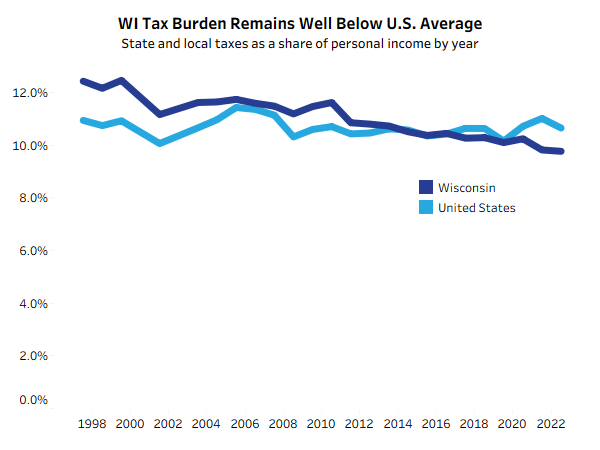
State Tax Burden & Ranking Remain Low
Wisconsin’s state and local tax burden fell slightly in 2023 to a new all-time low, driven by property tax limits, strong income growth, and modest income tax cuts. Over the last quarter-century, Wisconsin has gone from one of the nation’s highest tax burdens to well below average, and has also seen its spending levels and rankings drop in areas such as K-12 education. But this major shift in policy is becoming more difficult to continue.
Funding the First Years and Beyond
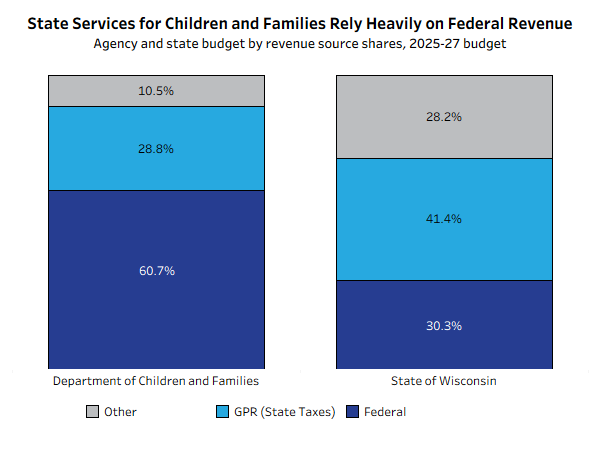
State and Local Options to Raise Revenue for Child Care
The need for affordable child care has become an increasingly pressing policy issue facing families, employers, and governments. Wisconsin residents seeking to raise additional revenue to address the issue will find that they have many more levers available at the state level than the local level, which could mean more opportunity for broad-scale solutions but also fewer opportunities for local initiatives like those seen in other states.
This is a shortened version of the full update. More information about each of these items is available on our website.
CoSN 2026 Driving K-12 Innovation Report
A global advisory board made up of education leaders, practitioners, changemakers and industry partners, collaborated in putting together this annual report, which is a continuation of the annual Driving K-12 Innovation Series.
CoSN/AASA EmpowerED Superintendent edLeader Panel Series
Register for the Upcoming Broadcast: Cybersecurity Priorities, Policies, and Practices for K-12 Leaders - March 9, 2026 (5:00 PM Eastern Time)
Previous Broadcast Recording: Managing Student Data Privacy: Highlights of the CoSN 2025 National Student Data Privacy Report
NREA Partners with SchoolSims for “Lead Where You Are” Webinar Series
Rural districts are not small versions of big systems. They are different systems with different constraints and different strengths. This three part NREA x SchoolSims webinar series is designed for rural and small district leaders who are building strong people systems with limited capacity. We will focus on practical, rural ready strategies for recruiting and selecting staff, strengthening onboarding and support, improving retention, and building sustainable structures that protect culture and reduce leader burnout. The series is offered at no cost to NREA members.
Session – April 23, 2026 at 2pm CST
Register here: Small District Budget Crisis
In this webinar we will explore some of the key challenges in navigating the district budgeting process. Often, the challenge begins with understanding the context and underlying Tradeoffs that are at play – finding the balance between the needs of specific community members while deciding what is in the best interest of students. At the same time needing to determine to what degree you can balance transparency and confidentiality. During the Webinar, participants will engage in a simulation that places them as a new Superintendent taking over a small school district that happens to be the primary employer in the community. When a budget shortfall is discovered, participants, as the Superintendent, must decide which resources to involve in the resolution while balancing transparency and strategy among key constituencies. They will need to decide which conditions warrant more persistence versus flexibility while keeping the focus on students.
Session – May 28, 2026 at 2pm CST
Register here: Political Leadership in the Superintendency
The goal of this Webinar is to help aspiring and sitting superintendents to explore a Political Leadership Framework to hone their skills so that they can more effectively lead change through complexity. We will share the Framework and then engage in a Superintendent level Simulation to challenge participants with various scenarios that require them to engage in the following proactive political leadership skills: visioning, communicating, political mapping, mobilizing and relationships building, while gaining and sustaining public trust and internal support. The central issue in the simulation exercise focuses on a district’s discipline policy and its relationship with school safety—an issue that nearly all superintendents will encounter throughout their career.
Policy Intelligence and Education News
I. Policy Intelligence and Education News - March 4th
“ ‘What is the Point?’: Conservatives spar over Education Department breakup” – Politico’s Weekly Education newsletter has an informative article quoting several conservative education leaders including President George W. Bush’s Education Secretary Margaret Spellings who do not think the Administration’s actions to transfer education programs to other agencies is enhancing student achievement or lowering bureaucracy. The article has links to several other articles available only to Politico Pro subscribers about complaints about the implementation of the interagency agreements. I find it interesting that some conservatives are going on the record on this issue now.
Department of Education reports highlight challenges –
Inspector General’s “Fiscal Year 2026 Management Challenges Facing the US Department of Education” – This report issued in late January identified five management challenges: “change management,” oversight and monitoring of grantees, oversight and monitories of student financial assistance programs, data quality and reporting, and information technology security. The report is based on investigations through September 2025, so it covers the period of mass layoffs and funding transfers but not most of the interagency agreements to transfer programs to other agencies that were announced in November and February, although they are mentioned in the report as part of the changes that ED needs to effectively manage. Other changes are getting rid of half the agency’s staff, terminating billions of grants and contracts “most notably, for teacher training grants…and large-scale research studies.” This is a helpful document that I recommend you peruse.
Institute of Education Sciences recommendations for reform – Last week ED’s Institute of Education Sciences (IES) sent the Secretary a report with recommendations for “reimagining” IES (see ED press release here, IES report). It notes the importance of continuing national education data at the National Center for Education Statistics but recommends reforming the three other centers and parts of NCES to better align grant-making with states’ needs, make research timelier and more relevant, make reports more accessible, among other recommendations. It recommends focusing grants on a just a few, “most urgent education challenges,” streamlining data collection and analysis, encouraging multi-state grants to facilitate growth of successful strategies (this reminds me of the “Race to the Top” grants funded by the 2009 Recovery Act). From what I understand, ED cuts the number of IES staff from about 130 to 30, so it seems likely that IES will be reducing the work it does in future just because of lack of staff, in addition to any change in priorities.



Wisconsin School Safety Coordinators Association